
Robots/Parts/Training
Cosmos
A family of AI models from Nvidia, called world models. They learn how the physical world looks and behaves from huge amounts of video, so they can create realistic video of situations that never happened, predict what happens next, and reason about a scene. Robot makers use them to make extra training material, for example the same task in many different rooms and lighting, without filming it all for real. The current version, Cosmos 3, can also produce robot actions directly.
- 1 of 15
- robots in the database
- Nvidia
- made by
- Training
- brain layer
- Free
- listed price
Key numbers
- Made by
- Nvidia
- Current version
- Cosmos 3, released in May 2026
- Sizes
- Super with 64 billion parameters, Nano with 16 billion and Edge with 4 billion (parameters are the adjustable numbers a model learns)
- What it takes in
- text, pictures, video, sound and robot actions
- What it puts out
- text, video, sound and robot actions
- Smallest version runs on
- Nvidia Jetson robot computers, including Jetson Thor
- Licence
- OpenMDW-1.1, an open licence
Source: NVIDIA/cosmos on GitHub (github.com)
Price guide
Listed price
Free
The code and models are free to download under the open OpenMDW-1.1 licence. Running the larger models needs powerful Nvidia data-centre graphics chips, which cost a great deal to buy or rent.
Where to buySource: NVIDIA/cosmos on GitHub (github.com)
Strengths and trade-offs
Our analysisStrengths
Free and open, so any robot maker can use and adapt it.
Turns a little real footage into many varied practice examples.
Comes in several sizes, from very large to small enough for a robot's own computer.
Fits with Nvidia's simulators, Isaac Sim and Isaac Lab, which many makers already use.
Trade-offs
The largest versions need very expensive Nvidia hardware.
Made-up video can look right but get the physics subtly wrong.
Ties a maker more closely to Nvidia's tools and chips.
Getting good results takes extra training on the maker's own data.
Why robot makers choose it
Our readTeaching a robot by recording real examples is slow and costly, and real data rarely covers every room, object and light. A world model can fill those gaps with realistic made-up examples and test a robot's skills before it is built. Hexagon says it uses Cosmos alongside Nvidia's simulators to design and check its humanoid robots.
This is our reasoning from the public facts. No maker has confirmed it.
Robots using it
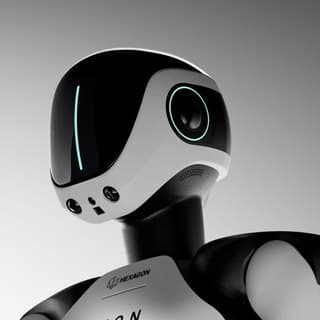
This list covers only the robots researched so far. A robot missing here may still use this part.
Numbers and listed prices on this page come from the sources shown. Anything marked as our analysis, our read or our estimate is our own view and has not been confirmed by any company. Last checked 15 Oct 2026. How we verify